
A Native Azalea Mini-Forest

Last month, I attended a conference with some terrific speakers. One in particular interested me.
He is a specialist at an arboretum, and his goal was to interest gardeners in adopting a local species in need. I have become enraptured with azaleas and am excited about possibly safeguarding an endangered plant that is native to my area.
So, a couple of fellow gardeners joined me on a field trip to the arboretum. It was a fabulous, although long, day. We learned about ways to identify endangered species, how to locate them near us, and then he took us to see the native plant nursery.
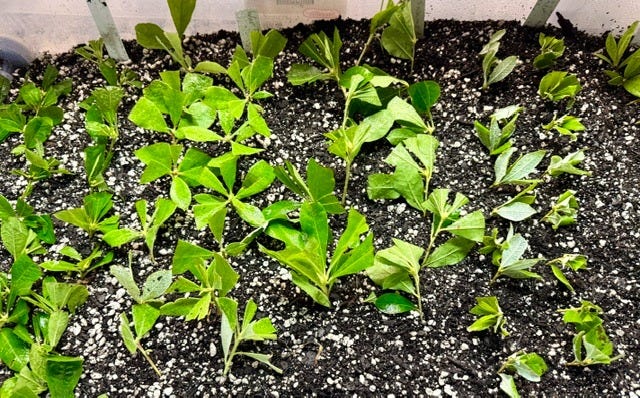
We geeked out! This very kind specialist showed us how to take cuttings, how to prepare them, how to plant them in a cutting box, and how to care for them.
Best of all, we took home several types of non-endangered species so that we could practice propagating before we tried our hand on the more precious types. The box (above) is now in my studio, under grow lights, and being misted often.
I have begun keeping a journal about these little plants, and hope that they will survive and be ready for potting up in a few months. If I am successful, I may graduate to more vulnerable specimens.
Patience is not my strong suit, but I am working on that. And having fun with another science project!
If you are interested in something like this, there are several sources of information. For example, if you live in Alabama, the Alabama Plant Atlas can tell you which plants are native to your county. Alabama also has a State Wildlife Action Plan, which lists priority species and actions being taken. I imagine that other states may have something similar.
Using the North American Plant Atlas, you can find where different species can be located. And the Center for Plant Conservation website explains best practices for conserving rare plants.
Good luck with your own science experiment! If we each do a little bit, we can accomplish a lot. Or as a friend of mine used to say, we can do more together.